Last month, Inquest published this article by Corinne Shanahan and Andrew Manuel Crespo on Jeremy Busby and other journalists behind bars’ experiences with endless retaliation:
In the summer of 2023, after a bad batch of meth made its way into his sweltering Texas prison, Jeremy Busby came close to being on the nightly news.
His prison had authorized a local television reporter to interview him about that summer’s slew of overdose deaths and other drug-related violence. But when the reporter showed up for the interview, she found the prison had transferred Busby, who has been incarcerated for over twenty-five years, across the state the night before.
According to Busby, the reporter was initially undeterred by this setback. She arranged to drive herself and her camera crew over 300 miles to interview him at his new facility. But then the prison blocked that interview, too. She did not try again.
In a relentless news cycle, canceled interviews often mean lost stories. And with them, lost opportunities for a public whose attention is increasingly fragmented to learn what is really happening inside the most secluded public institutions in the United States: our prisons, jails, and detention centers.
Cloaked in secrecy, insulated from press scrutiny, and cut off from the rest of society, these places often conceal violence, harm, and deadly oppression—all inflicted in the name of, and funded by, a public generally left unsuspecting and unaware.
By silencing Busby, his prison administrators joined a long line of actors who have cultivated public ignorance about what happens behind bars. In so doing, they help preserve the very conditions that allow mass incarceration to endure.
Busby’s story was broken by Theodore Amey and Seth Stern for Columbia Journalism Review last March. When we first encountered it, we were struck by its similarity to stories we hear frequently from Inquest’s incarcerated contributors.
Launched four years ago by the Institute to End Mass Incarceration (IEMI), this magazine was founded to create a space where “the people closest to the problem, including those directly impacted by mass incarceration, can come together to share ideas and be heard as they pursue bold solutions.” As our founding editors wrote when we first went live, Inquest exists to break down the walls of the silos that separate us from each other, “in hopes that we might all be better equipped to break down other walls together.”
No one understands those walls better than the intrepid journalists working inside of U.S. prisons to share their lived reality with the broader public. Of the hundreds of essays published at Inquest since 2021, roughly a quarter have been penned by incarcerated authors. Through these voices and IEMI’s related advocacy work, we have seen up close the barriers prison journalists regularly confront. And we’ve realized we need to take a more active role—not only in publishing these authors, but in working to advance and protect the rights of incarcerated and non-incarcerated prison journalists across the country.
As an institute rooted in the combined power of law and organizing, we are launching a new project aimed at identifying promising legal interventions that would improve conditions for prison journalism—with a broader goal of ushering a series of Prison Journalism Bills of Rights into law.
And as a magazine dedicated to helping those writers be heard, Inquest is pairing that advocacy work with this new series, Defending Prison Journalism, where incarcerated journalists across the nation, alongside experts and activists working to support them, will share essential insights into the challenges at hand and the path forward.
We spoke with over three dozen advocates and experts on prisons and press freedom, including over a dozen currently and formerly incarcerated prison journalists, about the challenges confronting prison journalism in the United States. Like others who have tackled this subject, we’ve discovered a web of state-made barriers to conducting even basic reporting on how U.S. prisons operate. Most of those barriers are rooted in policy decisions; all are enabled by law.
To hear more about the retaliation Jeremy has endured from Jeremy himself, listen to this interview from 2024 on the podcast Project Censored, “Exposing Prison Conditions and the Fight for Palestinian Rights“.
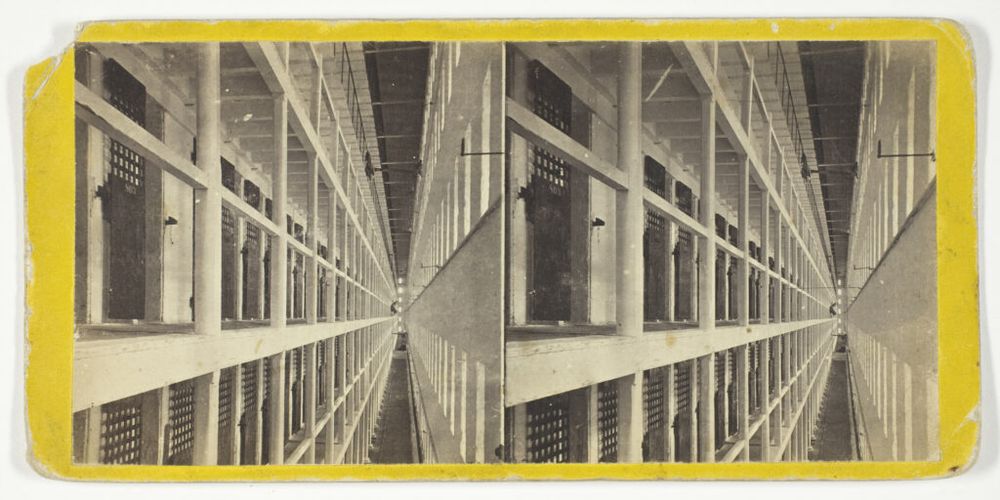
Image: “Interior view of the Main Hall of Prison, east side, which is 6 stories high, and contains 600 cells,” from Sing Sing Prison Views, a series of stereoscope slides printed c. 1860–69. In the collection of the Art Institute Chicago (public domain).
Leave a Reply