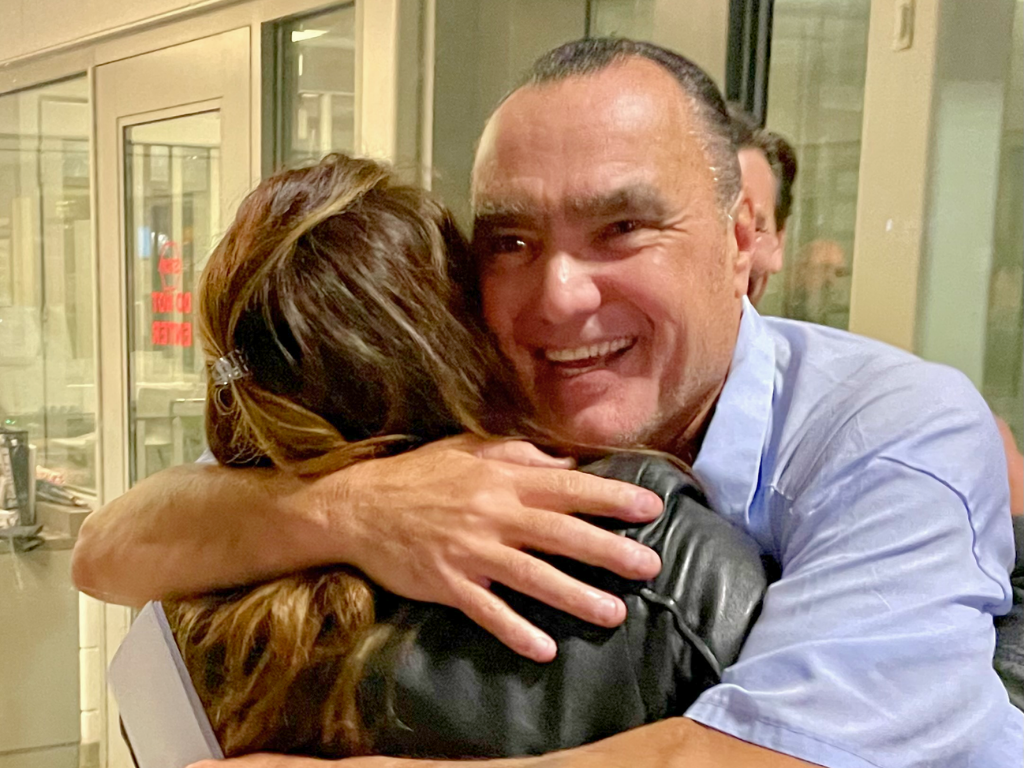
Pictured: Ronnie Carrsaquillo after he was granted his release in 2023. Source: X
By Jeremy Busby and Michael Montgomery
Ronnie Carrsaquillo was 20 years old when he was given a 200-600 year prison sentence for the shooting of a plainclothes police officer in Chicago. He spent his time in prison studying the law, obtaining college degrees, and mentoring others.
Despite his personal transformation and positive accomplishments, the criminal justice system refused to acknowledge his growth for 47 years.
Ronnie’s story is the subject of the PBS documentary In Their Hands, which is raising new questions about the country’s refusal to unlock new chances for individuals who commit crimes at a young age.
The film first aired in Chicago in 2024 but made its national debut in April in what juvenile justice advocates call “Fair Chance Month” (formerly known as Second Chance or Second Look Month). It’s a daunting tale of a broken system and one man’s fight for nearly five decades to fix it.
“There is rehabilitation, a person can change their life,” Ronnie said on the JustUS Speak podcast, presented by JustLeadershipUSA. “Give us a standard of fairness, a leveled playing field, instead of leveling the weight of the whole criminal justice system continuously upon me.”
Ronnie was reviewed for release by the parole board in Illinois at least 40 times. Rather than focusing their parole review considerations on the man he had become during his incarceration, the board members stayed fixated on the man Ronnie was at the time of the crime.
As a result, he was denied parole repeatedly. He was told by parole officials that his sentencing judge intended for him to die in prison. Luckily, Ronnie was able to recruit a legal team that won his release in what film producer Dan Professto calls “the old-fashioned way.” A new judge bypassed the parole board and granted Ronnie his release in 2023. At the age of 67, Ronnie walked out of prison.
This documentary highlights an American story that has become all too common in this country. There are hundreds of thousands of incarcerated individuals — like Ronnie — who are being held in prison long after becoming well-adjusted, transformed people.
A study cited by Equal Justice Initiative found that only 1.14% of people released after initially being sentenced to life without parole as children in Philadelphia were re-convicted of any offense. And in Michigan, only one out of 142 people released after the Supreme Court’s 2012 decision in Miller v. Alabama that sentencing kids to die in prison is unconstitutional had been rearrested as of 2021.
Judiciary branches have acknowledged the harm of excessive sanctions being placed on young offenders and have attempted to make corrective changes in sentencing guidelines.
In their historic ruling, Graham v. Florida, the U.S. Supreme Court held that sentencing juveniles to a mandatory life-without-parole sentence for a case that does not involve a homicide violates the prohibition of cruel and unusual punishment outlined in the 8th Amendment. It was Graham where the nation’s highest court pointed to the fundamental difference between juveniles and adult psychological development in their decision.
Neuroscientific evidence is clear that the human brain is not fully developed until, at the earliest, age 25. This causes a “lack of maturity” and “an undeveloped sense of responsibility,” according to court documents in the Graham case. These distinctive attributes of juveniles diminished the penological justification for imposing the harshest sentences, even when they have committed terrible crimes, the Court ruled.
Tough-on-crime politicians and states have found ways to circumvent the Court’s ruling by giving juveniles excessive sentences, with numbers instead of alphabets. Tough-on-crime politicians and states overlook scientific findings to disregard the potential for growth occurring during incarceration. Instead, their mentality is that “if you are old enough to do the crime, you are old enough to do the time,” said Professto in an interview with JustUs podcast.
Sentencing someone like Ronnie to 200 years in prison is a “death by incarceration” sentence. With mandatory minimums like in Texas, where this articles authors are from, anyone convicted of committing a violent crime has to serve at least 30 calendar years or half their sentence, whichever comes first. Any sentence of 60 years or more is in essence like. These guidelines restrict an incarcerated individual from even being considered for release, regardless of personal transformation, for decades.
One of this article’s coauthors, Jeremy Busby, is in the 28th year of a 75-year sentence for a murder that occurred when he was 19. During that time he has obtained multiple college degrees, served as the staff writer for the prison’s newspaper, became a certified peer support specialist, and worked with prison administrators to develop programming to help with the rehabilitation of other incarcerated individuals.
The other coauthor, Michael Montgomery, is in his 25th year of a Capital Life sentence that he received at the age of 14. He has also spent his time in prison educating himself and serving the incarcerated population as a peer support specialist and volunteer chaplaincy worship leader.
Neither of us has an existing parole file and must serve at least 30 calendar years before being eligible for review.
Fair Chance was the theme of New York Chief Judge Rowan Wilson’s 2025 State of the Judiciary speech. Chief Judge Wilson called on his colleagues to reconsider lengthy prison sentences.
“Keeping people incarcerated long term is a detrimental expense to the state,” he said. “It hurts communities and ultimately prevents incarcerated individuals from true rehabilitation.”
Chief Judge Wilson presented the stories of two incarcerated New Yorkers, Tami Eldridge and Christopher Martinez.
Eldridge is a 51-year-old who has spent the past 28 years in Bedford Correctional Facility. During that span, Eldridge earned multiple college degrees, including a Master’s from N.Y. Theological Seminary. She works as a teacher’s assistant and mentors new mothers at the Bedford Nursery.
Martinez is serving a 65-to-life sentence that makes him ineligible for release until 2049. Arrested at the age of 17, Martinez became the first person in his family to graduate from college during his time in prison. He would be 82 years old when he is released.
These efforts by Chief Judge Wilson were also meant to support legislative action known as Second Look bills. A growing trend for addressing this over-sentencing crisis, these bills allow a sentencing judge or court to reevaluate a sentence after a number of years. In some states the threshold is ten years; in others it’s 20.
These measures are being praised and supported by a coalition of criminal justice reformers, including Ronnie.
“If it took 47 years for them to fix me, they need a new profession,” Ronnie said about prison rehabilitation officials in Illinois. “They are not too good at what they do.”
The consequences of tossing young people away for life are countless. In Their Hands documents all of the harmful effects that Ronnie’s decades of incarceration had on both him and his family. It’s a story that will leave you infuriated, inspired, and informed.
“At the end of the day, it’s about humanity,” Ronnie said empathetically. “About helping human beings.”
Jeremy Busby and Michael Montgomery are both incarcerated in Texas. Jeremy is a writer and activist. He is the founder of JoinJeremy, a nonprofit dedicated to advancing the work of incarcerated journalists and writers across the country. Michael, also known as The Juvenile Lifer, is a juvenile justice advocate, an incarcerated peer support specialist, and a chaplaincy worship leader. He has been incarcerated since he was 14.
Leave a Reply